The Catalina Island rattlesnake (Crotalus catalinensis) is a unique rattlesnake species found on the Catalina islands off the cost of southern California. The LAIR team has taken a keen interest in studying the reproductive behaviors of this rare snake. These beautiful rattlesnakes have different color morphs, with some being darker than others. The coloration difference mirrors the different areas of the islands the snake is from. Darker coloration indicate a soil-based environment with more vegetation as cover, while lighter colors blend in with a sand-based substrate with rocky outcroppings and arid scrub. Check out the differences below:
Dark pigment blends in more effectively with darker soils and vegetation cover
Lighter pigment matches with rocky and sandy environments
Over the
course of many years and multiple expeditions to Catalina Island, the
team has successfully bred the rattlesnakes in captivity. In fact, the team's breeding program has become one of the most successful rattler breeding programs in the country.
Some of the more unique animals at the LAIR are the Gray's monitors (Varanus olivaceus). These medium sized monitors can be found in the Philippines and are rare in captive collections. Perhaps the most striking characteristic of these monitors is that their diet consists mostly of fruits.
V. olivaceus are arboreal and can often be found in the trees
While the reproductive behavior of these lizards is relatively unknown, LA Zoo has taken a keen interest in captive propagation. Using learnings from their experience with breeding Komodo dragons (Varanus komodoensis), the LAIR team continues to refine their methods with the hope of successfully rearing babies.
V. olivaceus foraging for food on the floor of the enclosure
Gaboon vipers (Bitis gabonica) are the ultimate ambush predator. These thick-bodied snakes lie in wait for prey and strike out with explosive force. When threatened the Gaboon viper puffs its body up to look bigger and forcefully blows air through its windpipe to make a loud hiss. Although they look clumsy and fat, they're capable of striking with incredible speed and are considered by some to be the fastest strikers in the snake world. Known as butterfly vipers for the gorgeous chevron pattern on their back, the gaboon viper is endangered and has become increasingly rare due to habitat destruction.
One of the LAIR's gorgeous West African Gaboon vipers (B. gabonica rhinoceros)
Gaboon vipers are famous for having the largest fangs in the snake world. Reaching up to 2 inches, these fangs act like hyper dermic needles, allowing the snake to quickly dispatch prey by injecting large quantities of venom deep into the body cavity. This not only immobilizes prey rapidly, but also decreases the change of damage to the snake itself. Rats and mice have large incisors and could easily injure the snake. Check out the fangs from a medium sized gaboon below:
Check out the size of Gaboon viper (B. gabonica) fangs
I
had the good fortune of being asked by Jarrod to assist the Animal World and Snake Farm Zoo (AWSF) team in the annual
croc move this past November. Once a year, Jarrod and his team have to move their adult crocodiles
into a winter enclosure. Normally, the weather in Texas is fairly warm, but the
weekend of the croc move was hit with an unusual arctic blast. I
flew to San Antonio International Airport at 3 am when the temperature dropped
to a chilling 36 degrees Fahrenheit. Zipping up my jacket, I hopped into my
rental car and drove to the hotel to catch two hours of sleep. My alarm buzzed
at 6 am and I shivered off the chilly morning as I headed out to meet Jarrod.
The moment I drove in, I saw the team had already gathered. As I parked my car
and walked toward the group, I immediately saw a familiar face. Jarrod was
already geared up and was fielding questions from the group about the biology
of crocodiles. We waited for a few more people to join us, and then Jarrod gave us a
rundown of the day. Most important, he said, was that no one get bitten. Jarrod
scheduled the day such that we would warm up with the smaller, juvenile crocs before
heading to the croc pond to move the larger adults. We
first had to prep the winter enclosure. Forming a line, we cleared branches,
bushes, rocks, cinder blocks, and other debris so we could move about freely
near the enclosure. The last thing we want when carrying a 10-foot croc is
tripping over a twig! While the team cleared the area, Jarrod and his
assistant, Caleb, set up the pump to drain the croc pond. Lowering the water
level not only made it safer to work with the crocodiles, but also allowed us
to clean the buildup of mud, rotting leaves, and feces that had been accumulating
at the bottom of the pond. We rolled the flexible pipes out behind the
hyena enclosure to drain the water into a holding pond. Using rocks and sticks,
we propped the pipes away from the hyenas. With jaws capable of exerting 900
lbs per square inch, the hyenas could easily bite right though the pipes. The rumble of the pump’s engine signaled that we were moving to the next
stage of our croc move. There
were four juvenile Nile crocs (Crocodylus niloticus) that had outgrown their
nursery. Even though they were only about five or six feet in length, they
still had the potential to cause serious damage. Before entering the enclosure,
Jarrod briefed us on the procedure: cover the eyes, jump on the croc, restrain
and tape the jaws, and control the animal during transport. While Jarrod
prepped the team, he gave me the keys to unlock the gates and doors. The moment the first croc was restrained, I was to run ahead
of the team, unlock the gates and the doors to ensure a clear path through the park
to the winter quarters. The cold had not let up and I fumbled to get the keys
to unlock the rusty locks. I heard the team yell as the first croc was
restrained. My frozen fingers were struggling to unlock the gate while I heard
Jarrod’s voice booming down the path! CRACK! I twisted the key one final time
and the lock burst open just as the team hauled the six-footer in. Phew! As
the team got more comfortable moving the crocs, the other juveniles were
quickly restrained and transported. Now, it was time to turn our attention to
the big leagues.
The team gathers to cover last minute details
Jarrod
gathered the team before we entered the croc pond. He coached us through the
procedure one last time. “HOOYAH!” We yelled after our little huddle and we
walked into the croc enclosure.
Surveying the croc pond (notice the giant gator near the pipe)
The
croc pond enclosure was a fenced in area with a huge pond in the middle
and housed a wide array of crocodilian species, from alligators (Alligator
mississippiensis) to the Morelet’s crocodile (Crocodylus moreletii). Even before
we stepped in, the gators and crocs were agitated. Now that we were in their
territory, they viewed us as a threat. Jarrod spotted Sam, the 13-foot alpha
male. As the rest of us scurried around to put down our gear, Jarrod and Caleb
brought out a rope and ran to the far bank to lasso Sam. The team looked on as
Jarrod juggled the cold, stiff rope around Sam’s massive jaws. After several
attempts, they snagged him! “Pull!” Jarrod yelled as we all rushed to grab the
rope and drag the enormous gator onto land. “Ok, everyone! This is it!” Jarrod shouted
as he and Caleb broke from the group and prepared to jump the 13-footer.
“Sean, I want you right behind me,” Jarrod instructed, not taking his eyes off
the gator. I positioned myself behind Jarrod as the team pulled Sam from the
water onto the bank. I heard Jarrod count down and before I knew it, he was
airborne. I jumped right after him and slammed onto the reptile. Check out
how it went down below.
As the rest of the team took
over for transport, Jarrod, Caleb and I took a quick second to recover. I
wasn’t sure if I was shaking because of the cold or because of the adrenaline.
But that was only the first one.
Look at the size of Sam's jaws!
The
morning chill hadn’t abated and now that I was wet from wrangling, the chill
cut through me even more. As Jarrod handed me the lasso, it was my turn to
bring one of these crocs in. I heard Caleb yell as he spotted one of the large
Nile crocs swimming in the pond. I forced my shaking legs into overdrive and
jumped onto the embankment. My eyes locked onto the snout of the huge croc. I
tossed the lasso into the water, but the rope was stiff and difficult to
loop around the croc’s snout. “C’mon.” I whispered to myself as I flicked the
rope over the crocs muzzle. BAM! I pulled the rope but the croc had twisted out
of the loop. “There he is again!” Jarrod’s voice rang out. Gritting my teeth, I
tossed the rope again. It landed across the croc’s snout. I exhaled,
trying to calm myself down. BAM! The rope snapped tight as the croc surged
forward trying to break free from the lasso. The power of the ten-foot Nile croc
nearly pulled me into the dark water. Immediately the team behind me grabbed
hold of my waist, fighting to keep me from being pulled into the water. Even
though my fingers were frozen numb, I could still feel the dull pain of the
rope as it burned through my hand. My fellow team members saw that I was having
trouble with the rope and immediately jumped in. Having the support of teammates
who would risk their lives for me fueled me to regain control of the rope. I
scrambled across the embankment, twisting my ankle in the process. But I knew
that we had to secure this croc as quickly as possible. Crocodiles build up
lactic acid in their muscles when they exert themselves and can exhaust
themselves to death. Add to that the bitter cold, and we could have had an
emergency situation if we took too long to secure the reptile. There was no
room for error or injury. As the team jumped in to grab the rope, we dragged
the gorgeous croc onto the bank. Jarrod gave the signal to jump and secure the
jaws. Another one down.
Now,
with two large crocs under our belt, we began to work more efficiently. We covered each other to make sure that none of us fell into the danger zone. When
a situation arose, we all would step in to diffuse it, even if it meant
putting our own lives on the line. The camraderie, grown out of our united
mission to safely and securely move these crocs, gave us the strength to fight
off the wind, the mud, and the fiesty crocs.
As
we transported the crocs one by one, Jarrod handed me the rope and told me that
the next croc would be mine. I pivoted my attention to the beautiful Morelet’s
crocodile (C. moreletii). Morelet’s crocodiles are endangered in their
natural range in South America and AWSF is one of the few institutions in the
US to have an adult specimen. These crocs have stunning patterns on their backs
and have been hunted nearly to extinction for their skins. While Morelet’s
crocs aren’t the largest croc species, their attitude more than compensates for
their lack of size. I knew I had to be extra careful when securing this
specimen and didn’t want to miss on my first shot. Without the protection of
the water, the croc was fully exposed to the cold air. Every second counted. I
stepped into the mud, edging closer to the croc, and tossed the lasso around
the croc’s jaw. Jarrod positioned the lasso with a long pole. SNAP! I pulled
the lasso and the croc struggled. Handing off the rope to the team, I
positioned myself behind the croc, ready to jump. I threw a t-shirt over the
croc’s eyes. WHAM! I landed on the croc, my hands locking around the powerful
jaws. The mud was so slick that I fell to my side, taking my right hand off the
jaws to support myself. Immediately, Jarrod grabbed the jaws to ensure that the
croc didn’t twist free. After regaining my balance, I secured the croc. Check
it out below!
After
a long morning, the adrenaline began to wear off. Hours of intense croc
wrangling in the cold left us all exhausted. But the fellowship of the team
kept each of us strong and in good spirits. The dynamic in the croc team
reminded me of my training at West Point: every person in the squad trusted
each other and was ready to put his/her life on the line to save each other. As
we sat back to enjoy a well deserved break, we reflected on what had just
transpired. We pulled off the entire croc move without incident, no injuries to
us or to the crocs. What an experience!
Mountain lions go by many names, cougars, pumas, red tigers, deer tigers, etc. They hold the Guinness Book of World Records title for having the most common names of any animal. Called Puma concolor by scientists, the mountain lion is one of my favorite big cats. A top predator, males of this species can reach 8-feet long from nose to tail and weigh over 200 lbs. These regal cats hunt elk, deer, grouse, virtually anything they can overpower.
The majestic mountain lion. (Image courtesy of Wikipedia).
Animal World and Snake Farm Zoo (AWSFZ) is home to three precious cubs (please see Expedition: Animal World and Snake Farm Zoo for a brief introduction). Angel and Sarah
are sisters; Edward is a young male unrelated to the other two. All three of them were born at a zoo in Arkansas and were
taken in by AWSFZ to serve as ambassadors of their species, helping in educational programs and conservation
efforts. They were hand-raised by Jarrod and his family and, despite
having the size and power of America's top cat, are very gentle when
dealing with humans.
They love playing; jumping, chewing, and pawing at things. This
behavior is thought to help them develop their reflexes and muscles used
in hunting.
Angel, one of our cougar cubs, playfully chewing on my shirt.
When working with large reptiles, there comes a time when you might need to restrain the animal for inspection purposes, whether for medical reasons or transportation to a new enclosure. I learned from the best croc wranglers in the US, Jarrod and Bart, and had the opportunity to help restrain a 6.5-foot Nile crocodile.
Prepared to safely transport a 6.5-foot Nile crocodile!
After jumping on the croc, the first order of business is to secure the jaws with electric tape. Once that's accomplished, the tough part begins. (Notice that in many of the photos, the large 12' saltwater crocodile in the enclosure right next to me has her mouth open!)
The croc is so powerful I have to use my entire body weight to control it
"I think I got it."
With a simple turn of its neck, the croc easily escapes my grip. Thank goodness for the tape.
To regain some semblance of control, I gently cover the croc's eyes to keep it calm.
Taking a quick rest as Bart keeps a watchful eye in the background.
The tail of crocodiles, caimans, and alligators is solid muscle. They use this muscular appendage to power themselves, capable of reaching 11 miles per hour on land and up to 30 miles per hour in water! The tail also provides tremendous torque when the animal twists around to free itself. I almost lost control!
The massive tail whips around, ripping the croc out of my grip!
BAM!!! I have no choice but to pin the croc with my body. Notice the giant saltwater croc in the enclosure behind me. She's 12-feet long and could easily rip off my leg with her jaws. Luckily for the fence, that didn't happen.
Here's some footage of the struggle. Check it out!
(The squawking in the background are macaws and cockatoos.)
I try again, knowing the full power of this "small" croc.
I make sure to control the tail with my feet and cover the eyes with my hand.
I gently secure the neck and head, while keeping control with my feet.
Up we go!
Almost there!
YES! After struggling to secure the animal, we're ready for transport!
At the end of the day, the safety and health of the animal is our top priority. Even though the handling may seem invasive, it's a standard practice for securing large reptiles. Jarrod, Bart, and I take the handling of the zoo's animals very seriously and go to great lengths to ensure the safety and well-being of each animal.
One of Animal World and Snake Farm Zoo's (AWSFZ) specialties is crocodilians (please see Expedition: Animal World and Snake Farm Zoo page for a brief introduction). The zoo cares for one of the most diverse collections of crocodiles in the country. It is amazing to work with such a wide range of
species in such close proximity. From the caiman, the smallest crocodile species in the world, to the giant saltwater and Nile crocs, the two largest reptile species in the world, AWSFZ has them all. Check out some of the beauties:
A cuban crocodile (Crocodylus rhombifer)
Sam, the zoo's 13-foot American alligator (Alligator mississippiensis)
A gator coming out of the Croc Pond to check us out
A west African Nile croc basking in the sun
A beautiful east African Nile croc (blond in the center)
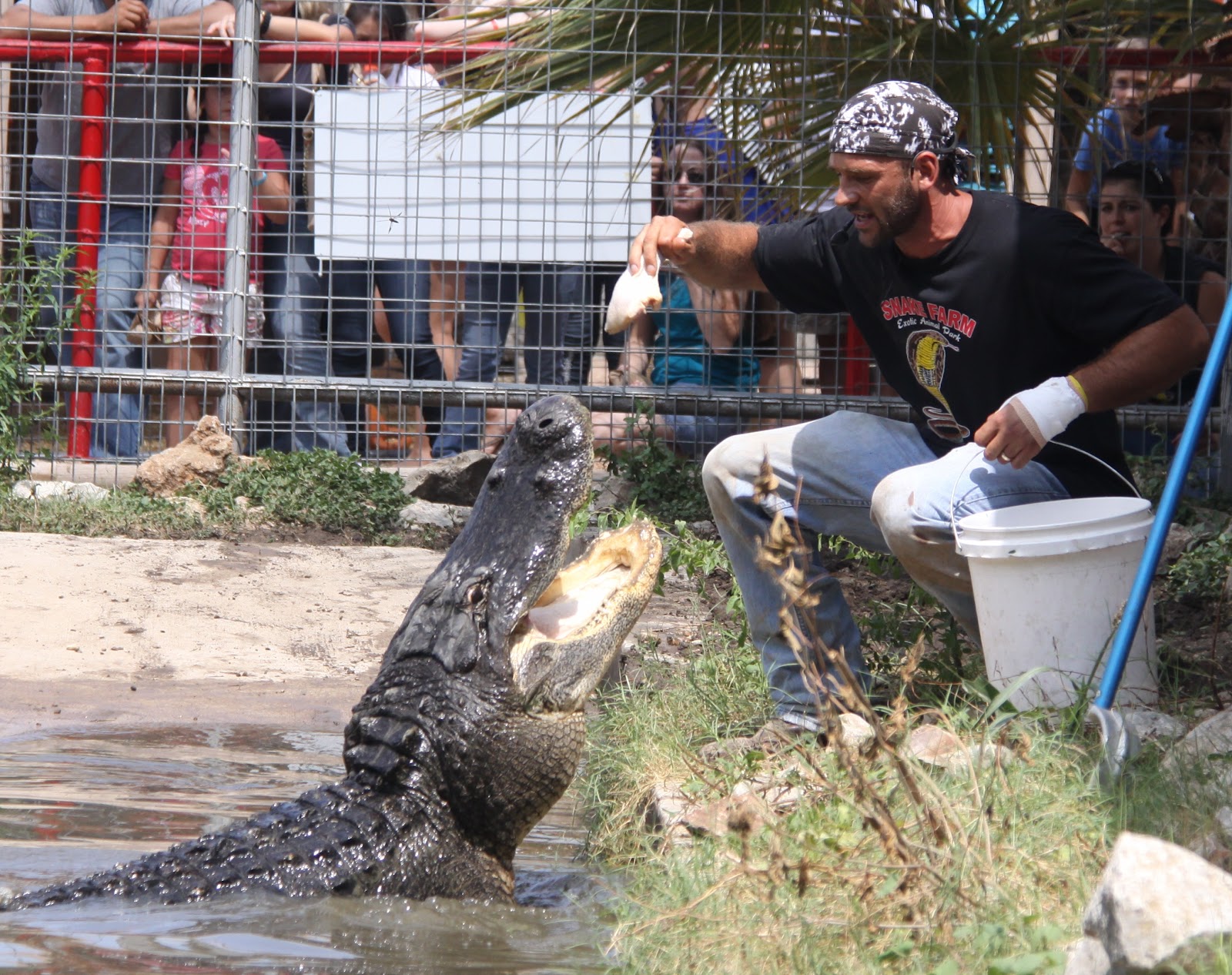
Every Sunday during the summer, Jarrod and the AWSFZ team feed the crocs by hand in a show for the public. The weekly "Croc Feeding" is a huge attraction. Check out what I mean:
Jarrod taking a break to educate the public about this gorgeous east African Nile crocodile
Despite having an injured left hand, Jarrod continues the show with a smile on his face. What a trooper!
Jarrod and Sam, the alpha male gator. Look at those jaws!
Jarrod and one of the medium-sized gators. Check out the size of that reptile!
Even with his left hand out of commission, Jarrod still gives the crowd an amazing show
Jarrod and Bart are the only people allowed in the Croc Pond during feeding sessions. With over 20 years of experience working together, Bart and Jarrod depend on each other. Bart is Jarrod's only life-line and if things get a bit toothy, Bart is there to back Jarrod up.
A bunch of crocs cornering Jarrod and Bart
Jarrod trying to get chicken out as fast as he can
Of course, when you're working with giant, toothy reptiles, there are always close calls.
A hungry east African Nile croc
A Nile croc that's more interested in Jarrod than in chicken. Check out those teeth!
Another close shave
After a successful show, Jarrod and Bart gave me unprecedented access to the giant crocs in the Croc Pond. Having worked with giant crocs before, I was familiar with the safety precautions required. But I was still sweating bullets!
Contemplating my next move in the Croc Pond.
Me and a 10-foot Nile crocodile, the second largest reptile species in the world!